The Village of Birnie
BRIBING THE BARBARIANS: Excavations at Birnie and the impact of Rome on the Highlands
by Dr Fraser Hunter (from Electric Scotland 2005)
As part of Highland Archaeology Week programme, Inverness Field Club invited Dr
Fraser Hunter of the National Museums of Scotland, Edinburgh as Director of the excavations
at Birnie, Elgin over the last few years to present this special annual lecture.
His colleague, Mr John Wood, formerly Senior Archaeologist with Highland Council,
now freelancing as Consultant set the scene relating to the Romans in the North -
This was not local, showing the group were in contact with other Iron Age groups. They also had links with the Romans as shown by top of the range brooches decorated with enamel or silver, and a fragment from a high status box or piece of furniture; the Birnie 'budgie', one inch high lovely piece of enamelling with the eyes, feathers and webbing of feet all showing.
In 1999, ten coins were found, so in 2000 they put in a trench at this point. Another eleven coins and pieces of pottery were the clues to a hoard of 315 denarii, equal to a year's pay for a soldier, found buried in the heart of the settlement. It dated to 197, ten years before Emperor Severus invaded. One coin had a fingerprint on it; another was fake lead with silver foil over it. The hoard was in a pot, lined with bracken, a whole range of material was preserved, including a leather pouch, a very rare occurrence.
In 2001 excavations found the top of a pot -
Emperor Severus crossed the Forth, and may have campaigned up to the Moray Firth
but his campaign was not much of a success. Emperor Severus died at York in 211;
the Roman propaganda recorded success -
The Birnie finds are not unique -
What use were denarii around the Moray Firth? There was no money economy in the Iron Age.
Dr Hunter is of the view the coins were for a special purpose, not for melting down
(to make jewellery), but stuff to show off, sealing alliances, hiring mercenaries,
making votive gifts to gods, similar to the earliest Celtic coinage in Europe. Why
were they buried? -
For Photos of the excavation site, click here for web presentation.
Dr Hunter examined the evidence of finds from beyond the frontier looking especially
at Birnie. In 1966 Roman coins (denari) were found at Birnie, which was a long way
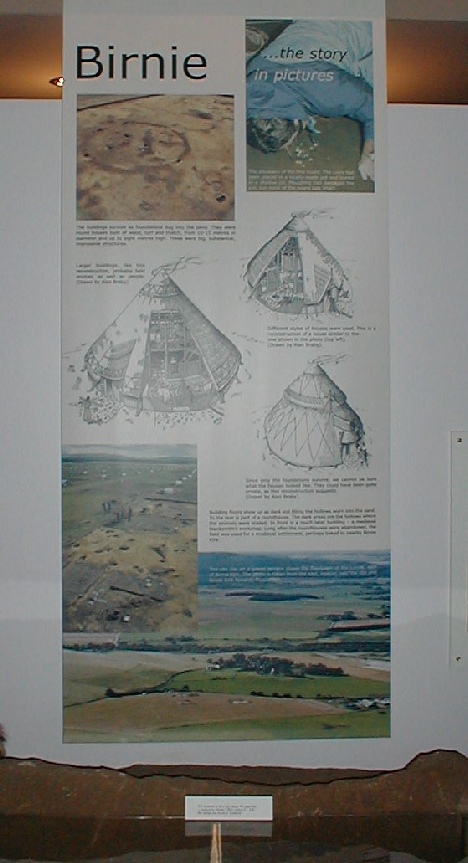
north of the Roman frontier in Scotland. An aerial photograph in 1980s showed a settlement
site with pits, postholes and marks of round houses. Our speaker wanted to research
the connection between the coins and the settlement. With funding from the National
Museum and Historic Scotland, and with responsible metal detecting by Hamish Stewart,
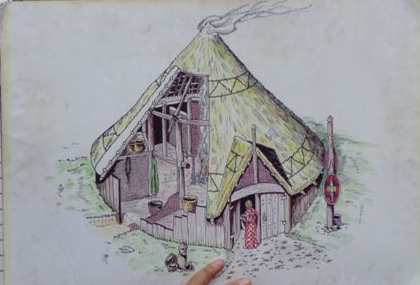
the dig was commenced. They found many prehistoric round houses -